
The Institute — Methodology
Once a baseline is established, training becomes structured. The Institute is a curriculum, not a series of hourly lessons — a defined progression through attention, decision-making, and planning, with fixed criteria for moving forward.
What happens
Students move through a structured ladder built on six observable competencies.
Progress is reviewed on a fixed cycle
— not by instinct, and not by rating alone.
- Attention stability
— remains engaged with a task; returns after distraction
- Impulse control
— pauses and evaluates before committing
- Decision quality
— generates alternatives and explains why one is stronger
- Planning and pattern recognition
— identifies structures and anticipates consequences
- Persistence and completion
— continues through difficulty rather than abandoning a task
- Error recovery and coachability
— regulates response to mistakes and applies feedback
Every Institute placement includes:
- A level-specific curriculum map
- Weekly practice assigned outside the session
- Written review notes after each game or task
- A defined review at set intervals, resulting in one of five outcomes: advance, continue, repair, pause, or conclude / refer
Who this is for
- Students who already have basic footing and want steady, structured development
- Families who want progress they can see, not just attendance
- Learners who can commit to a regular cadence and follow a defined system
The standard
No student advances without demonstrated readiness. Progress is reported on evidence — a specific behavior, a plain-language interpretation, a priority, and a next action — not a subjective impression.
What it is
The Institute is the curriculum engine of The Cognitive Lab.
It is designed to be standardized, level-based, and progression-led, so development does not depend on personality, improvisation, or random lesson flow.
Its purpose is to give each student a repeatable method for thinking better on the board and beyond it.
At this stage, students move from general potential into formal structure.
They learn how to slow down, calculate with discipline, evaluate positions with logic, and make decisions with greater composure.
The work is deliberate. The progress is measured.
What students build
Inside The Institute, students develop:
This is why The Institute matters.
It gives students a way to think in systems rather than reactions.
Calculation discipline.
Board vision and pattern recognition.
Structured planning and evaluation.
Emotional control during decision-making.
Reflection habits that turn mistakes into method.
How the method works
The Institute is built on a simple principle:
Thinking Improves when Structure is Repeated.
Each program follows a defined session architecture, fixed review intervals, written outputs, and objective promotion criteria. That is what makes the experience institutional rather than informal.
Students are not left inside endless hourly coaching. They move through a clear ladder of development, with each level carrying its own standards, deliverables, and readiness markers.
The Progression
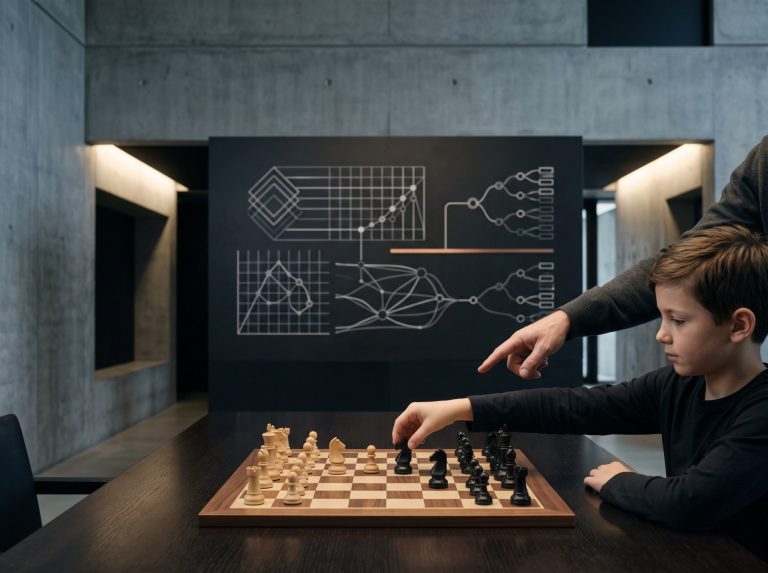
Foundations
For beginners and early players who need rules clarity, discipline loops, and core thinking structures. The focus is on reducing blunders, improving move reasoning, and building the habits required for stable learning.

Edge
For developing players with basic fundamentals who now need stronger planning, evaluation, and emotional regulation. The work becomes more strategic, with decision-tree analysis, game review, and timed application.

Mastery
For advanced students preparing for competitive performance. Here the emphasis shifts toward deep analysis, advanced calculation trees, scenario simulation, and tournament readiness.
What makes it different
Most chess coaching is coach-led. The Institute is system-led.
Its value lives in the methodology: level transitions, curriculum maps, homework, progression checks, benchmark reviews, and written standards for advancement.
That structure protects quality. It ensures that progress is visible, language is precise, and every student is held to a real developmental path rather than a loose series of sessions.